

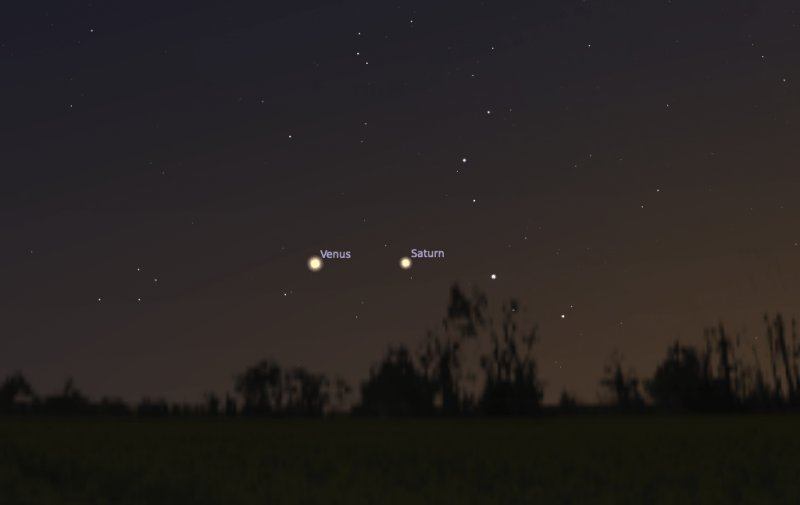
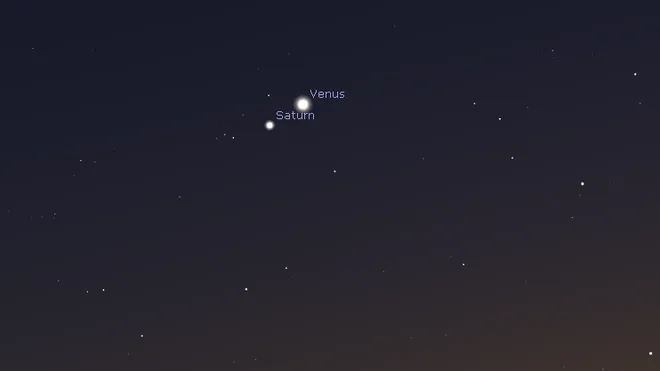
The night sky in March will offer a show worth pausing for. Between March 7 and March 8, Venus and Saturn will appear very close together in what astronomers call a planetary conjunction. Although the planets are actually millions of kilometers apart, they will seem almost side-by-side from Earth.
As a result, skywatchers will be able to enjoy a striking celestial scene shortly after sunset.
When and where to look
First of all, the best time to observe the conjunction will be about 45 minutes after sunset. During this short window, both planets will be visible low above the western horizon before gradually disappearing from view.
Importantly, the event will be visible across much of the American continent, including North America, Central America, and South America, as long as weather conditions allow clear skies.
You might be interested: Saint Patrick’s Day: the Irish celebration that turns the world green
A show for everyone
Fortunately, no telescope or special equipment is required. Venus, often called the evening star, will shine brightly and will be easy to spot. Saturn, meanwhile, will appear slightly dimmer but still visible close to it.
However, if you happen to have binoculars or a small telescope, you may enjoy an even clearer view of the two planets sharing the same portion of the sky.
A perfect plan after sunset
To get the best view, try finding a location with an open view toward the western horizon and minimal light pollution. For example, a park, rooftop, or backyard can work perfectly.
Then simply look up and take a moment to enjoy the rare sight of two of the solar system’s most famous planets appearing to meet in the evening sky.
March: a great month for stargazing
Finally, the conjunction of Venus and Saturn is just one of several astronomical highlights expected during March 2026. From eclipses to meteor showers, the sky will provide plenty of reasons to step outside and look up.
Sometimes, the best show on Earth…
is actually happening above us.
Note by AVG